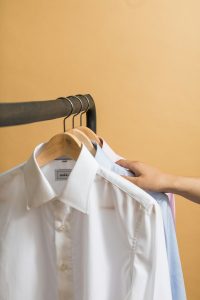
TL;DR / Summary: Tournament shirts fail in transit, not on the board. Pack them rolled, keep a travel kit that fits in one pouch, and accept that a steamer beats an iron in every hotel room you will ever be given.
Why tournament shirts crease so badly
A dress shirt is designed to hang. Folded flat in a case for six hours, the collar and the front panel take the pressure, and both are the parts people notice. Cotton poplin creases along the fold line and holds the memory of it for hours.
The fix starts at packing, not at ironing. Rolled shirts crease in curved lines that hang out with body heat, whereas flat-folded shirts crease in a straight line across the chest that stays visible all day.
Roll each shirt around a core—a rolled tie, a small pouch, or even a newspaper tube. The core prevents the sharp fold that creates a crease, and it costs nothing.
The kit that earns its space
Travel ironing kits expand to fill whatever case you provide. A disciplined kit is small enough to live permanently in the tournament bag, which means it is never left at home.
- Hand steamer — the single most useful item, and the one most often omitted
- Lint roller — small, and it makes a dark shirt look cared for
- Stain pen — a coffee splash at breakfast is a whole-day problem
- Collar stays — spares, because the originals vanish
- Small cloth — for pressing through, if an iron is unavoidable
Skip the miniature iron. Hotel irons exist, and the miniature version is heavy, slow, and rarely produces a better result than steam and patience.
Pack the kit in a pouch that lives in the bag. Loose items migrate, and a missing collar stay on the morning of a round is an avoidable irritation.
Steam first, iron only if you must
Most hotel-room creases come out with ten minutes of steam hanging in the bathroom during a hot shower. Hang the shirt on a hanger, close the door, and let the room do the work.
A hand steamer is faster and more reliable, especially for collars and cuffs where the fabric is doubled. Hold it a few centimetres away, work downward, and let the fabric dry before wearing.
If you must use an iron, use a damp cloth between the soleplate and the fabric, a low temperature, and a pressing motion rather than a gliding one. Press the collar from the points inward and never press a hard crease into the band.
The collar is the whole game
People read a shirt by its collar. A perfectly pressed body with a limp collar looks worse than a slightly creased body with a crisp collar, because the collar is at eye level during a conversation and in every photograph.
Steam the collar first while it is still slightly damp, shape it flat, and let it cool before folding it down. Cooling under shape is what sets the collar, which is why pressing a hot collar and immediately putting on a jacket wastes the effort.
A crisp collar rescues a shirt; a soft collar ruins a pressed one.
Fabric choices that travel well
Not all shirts are equal in a suitcase. Poplin is formal and creases; oxford is more casual and recovers; performance blends resist creasing but can look slightly synthetic under hall lighting.
A lightweight wool-silk blend or a treated cotton travels best of the traditional options. Both recover from folding and both look appropriate in a classical setting.
Match the fabric to the event. A club match tolerates oxford comfortably; a formal classical event rewards poplin or a fine twill. Packing two shirts of different fabrics covers both.
Between rounds
The midday break is the best opportunity to reset. Hang the shirt rather than leaving it folded over a chair, and give it a minute of steam if the kit is available.
Change your base layer if the day is warm. A fresh undershirt makes the shirt feel new and reduces the humidity that causes creasing during the afternoon.
Blot, do not rub, any marks from lunch. Rubbing drives a stain into the weave, and a stain pen applied to a blot lifts far more than one applied to a spread mark.
After the event
Hang the shirt as soon as you get home, and wash it before it sits. Collar grime sets over time and becomes permanent, and a shirt that goes into the wardrobe dirty will not survive many seasons.
Wash collars and cuffs with a little detergent worked in by hand before the main cycle. The machine alone rarely shifts the build-up at the fold line.
If the shirt has a stain you cannot identify, do not iron it. Heat sets stains permanently, and an unidentified mark is better left un-ironed until it has been treated.
Building a small rotation
Three good shirts rotate better than six mediocre ones. They wash and dry in sequence, they hang between events, and each one gets enough rest to recover its shape.
Keep one slightly more formal shirt for the last round of an event, when photographs are most likely. It sounds vain; it is simply anticipation.
For shirts cut for long seated rounds rather than standing fits, chess apparel is worth a look, but the packing and steaming routine is what keeps them presentable on day three of a tournament.